All resources

Executive Dynamics · Resource 05 of 15

C-Suite Archetypes

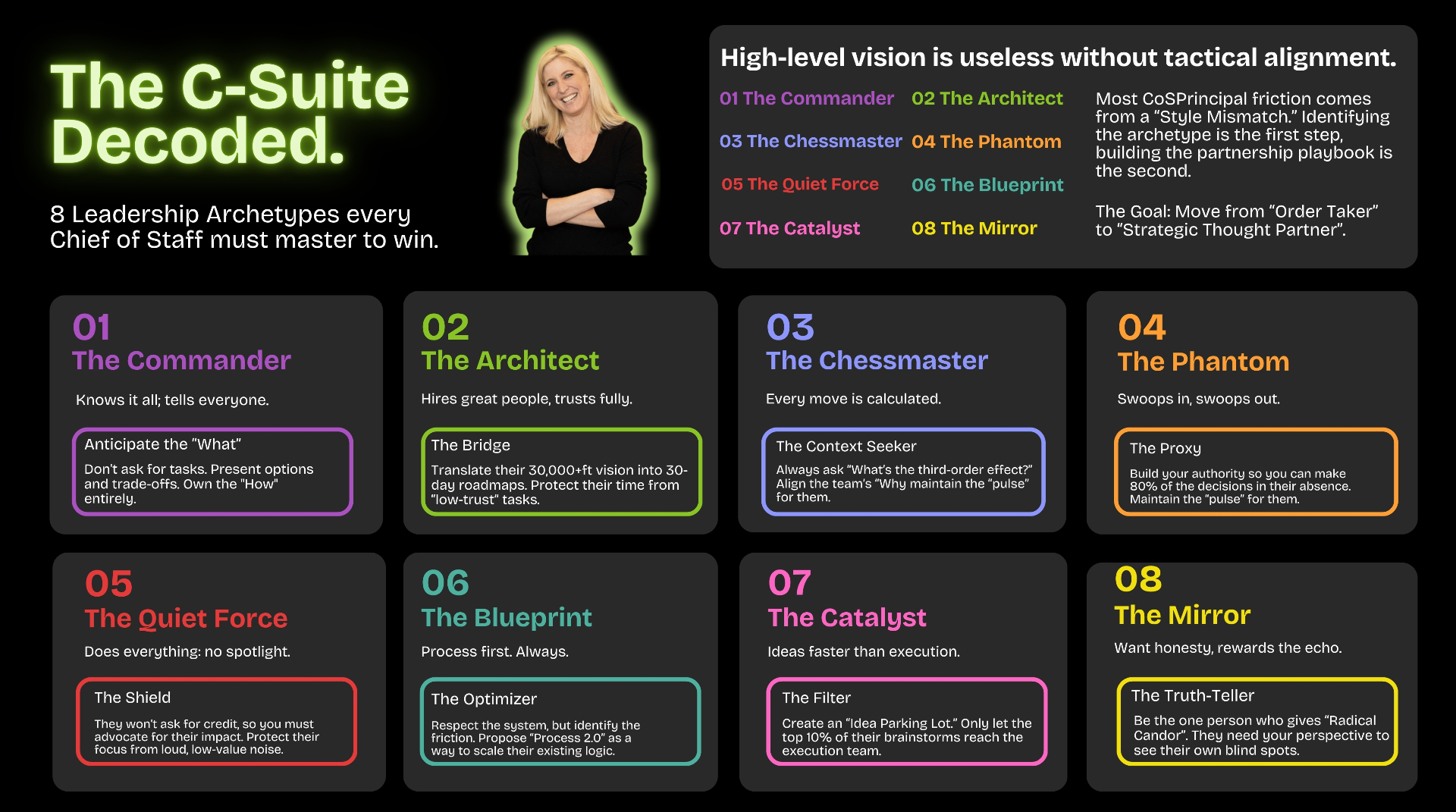
Eight archetypes every Chief of Staff will encounter — and how to partner with each. The Benadom CoS Framework for understanding who you're really working with.

15 min readExecutive partnershipOriginal framework

The Benadom CoS Framework

The C-Suite, Decoded.

Eight archetypes every Chief of Staff will encounter. Understanding who you're really working with isn't optional — it's the job. The sooner you name it, the sooner you can serve them well.

8

Original archetypes — The Benadom CoS Framework

3

Things every archetype has in common: blind spots, strengths, and a need for the right CoS

1

Thing that never changes: your job is to make them better at theirs

Why archetypes matter — and what to do with them

There's a difference between knowing someone's calendar and knowing their mind. A CoS can master the first in a week. The second takes observation, curiosity, and a willingness to be wrong about what you think you see.

You're not trying to put your leader in a box. You're trying to understand which box they keep putting themselves in — so you can help them out of it when it matters.
The CommanderHigh energy, high demand

The Commander

"I know exactly what needs to happen. I just need everyone else to catch up."

This leader has strong opinions about everything — the strategy, the process, the font on the slide deck. They move fast, decide quickly, and expect the people around them to execute without needing their hand held. They're often brilliant. They're also often exhausting.

What you'll notice

  • Every decision routes back to them
  • Meetings move fast but rarely close
  • The team is talented but underutilized
  • They interrupt — often with the right answer
  • Energy is high; follow-through is patchy

What they need from you

  • A filter — not everything needs their eyes
  • Someone who can pre-decide at their standard
  • Honest pushback they didn't ask for
  • A way to slow down without feeling slow
  • Visibility into what their team actually thinks

What not to do

  • Don't become another yes-voice in the room
  • Don't escalate everything — learn their bar
  • Don't protect the team from their intensity
  • Don't compete for the floor in meetings
  • Don't confuse confidence with certainty

The CoS Move

Build a decision filter together — a written set of criteria for what requires their attention and what doesn't. Frame it as giving them more time for the things only they can do.

The ArchitectHigh trust, high accountability

The Architect

"I hired great people. My job is to get out of their way."

This leader builds deliberately. They recruit well, delegate clearly, and operate with a calm confidence. The organization tends to be high-performing and healthy because it's been given both trust and accountability.

What you'll notice

  • Decisions happen at the right level
  • The team operates with real autonomy
  • They ask questions more than they direct
  • They notice everything, comment on little
  • Accountability is quiet but absolute

What they need from you

  • Someone who sees across the whole field
  • Early signals when something is drifting
  • Pattern recognition they don't have time for
  • Honest synthesis — not flattering summaries
  • A thought partner, not just an executor

What not to do

  • Don't create problems to solve — they'll notice
  • Don't over-report; signal the signal, not the noise
  • Don't assume silence means approval
  • Don't mistake calm for disengagement
  • Don't try to be the smartest in the room

The CoS Move

Develop your own strong point of view and learn to articulate it clearly. The Architect didn't hire a mirror — they hired someone who can see what they can't.

The ChessmasterHighly complex — proceed with clarity

The Chessmaster

"Every conversation is a move. Every relationship is a position on the board."

This leader plays politics not because they're malicious, but because they've learned it works. They are strategic about information — who gets what, when, and in what order. At their best, they are extraordinarily effective navigators of complex stakeholder environments.

What you'll notice

  • Information is curated, not shared freely
  • Alliances shift depending on the initiative
  • They read people faster than most
  • The "official" version and the real version differ
  • The team is loyal — or very quiet

What they need from you

  • Someone they can trust completely — earn this slowly
  • Honest intelligence they can't get elsewhere
  • A CoS who doesn't play the game themselves
  • Gentle reality checks without ego
  • Someone who protects culture quietly

What not to do

  • Don't become a conduit for political messaging
  • Don't share what you know with everyone
  • Don't pick sides in their alliance structure
  • Don't mistake being trusted with being safe
  • Don't let the culture normalize what isn't okay

The CoS Move

Be the one person in their orbit who is genuinely non-political. Don't trade information. Don't make moves. The Chessmaster respects the person who won't be played, because they're rare.

The PhantomStructurally difficult — demands discipline

The Phantom

"I was just in London. And Singapore before that. I'm back Thursday — or maybe Friday."

The Phantom swoops in and swoops out. They're present in the way a weather event is present — intensely, briefly, and with significant aftermath. A CoS working with a Phantom has one of the most demanding jobs in this framework.

What you'll notice

  • Calendar is chaotic; priorities shift without notice
  • The team makes decisions in their absence — then braces
  • They re-engage at high energy, then disappear again
  • No one is sure what they actually own
  • The CoS becomes the de facto leader by default

What they need from you

  • A system that keeps them connected without burdening them
  • A reliable brief when they re-enter — fast and clean
  • Someone managing their commitments in their absence
  • Decisions escalated only when truly necessary
  • An honest conversation about the cost of their absence

What not to do

  • Don't fill the vacuum with your own authority
  • Don't shield the team from the reality of the situation
  • Don't make your case when they first re-engage
  • Don't manage up in a way that embarrasses them
  • Don't carry the organization alone indefinitely

The CoS Move

Design a re-entry ritual — a standing brief format that takes them from zero to informed in ten minutes. Make it so good they start asking for it.

The Quiet ForceLow friction, high depth

The Quiet Force

"They don't say much in the meeting. But afterward, everything moves."

This leader does extraordinary things and never craves the attention for it. They're not performing leadership — they're practicing it. The organization around a Quiet Force is often quietly excellent — things work without drama.

What you'll notice

  • They listen more than they speak — and remember everything
  • They dislike self-promotion intensely
  • Their relationships are deep and genuinely mutual
  • They rarely ask for recognition
  • Their team is fiercely loyal without being told to be

What they need from you

  • Someone to make their impact legible to the organization
  • A CoS who amplifies without distorting
  • Help structuring their thinking for external audiences
  • Preparation for rooms that require performance
  • Protection from those who confuse quiet with weak

What not to do

  • Don't push them to be louder than they are
  • Don't take credit for the space they create
  • Don't mistake their softness for a limit
  • Don't make their introversion a problem to fix
  • Don't assume they need rescuing in a room

The CoS Move

Become their voice in the rooms they don't need to be in. Carry their perspective faithfully — not loudly, but clearly.

The BlueprintStructured — requires patience and precision

The Blueprint

"There's a right way to do this. Let's document it, version it, and not deviate from it."

Process is not a tool for this leader — it's a value. They believe deeply that rigor is respect. The organization they run is often extremely reliable. It can also be slow to adapt.

What you'll notice

  • Everything has a process — even the process for processes
  • Ambiguity makes them visibly uncomfortable
  • They want documentation before decisions, not after
  • Deviation from agreed process is a serious matter
  • They're often right when others are improvising badly

What they need from you

  • Total follow-through on every commitment
  • A CoS who builds systems, not workarounds
  • Early warning when something will break protocol
  • Help translating ambiguous situations into clear structure
  • A safe person to be imperfect with occasionally

What not to do

  • Don't improvise and tell them later
  • Don't present a problem without a proposed process
  • Don't confuse their rigidity with stubbornness
  • Don't be vague — ever
  • Don't rush them when speed isn't actually needed

The CoS Move

Learn to love a framework — and become the person who builds them. When deviation is genuinely required, bring a proposed exception protocol rather than just a reason.

The CatalystEnergizing but combustible

The Catalyst

"Everything is possible. Why are we not moving faster? Let's do all of it."

The Catalyst generates ideas at a rate the organization can't consume, changes direction with genuine enthusiasm, and inspires people to believe in things before anyone has figured out how to build them. The CoS to a Catalyst is essentially a landing system.

What you'll notice

  • Priorities change — often mid-sentence
  • Energy in the room is genuinely electric
  • The team is inspired and slightly overwhelmed
  • Brilliant ideas arrive without implementation plans
  • Boredom is their kryptonite

What they need from you

  • An idea triage system — not every spark is a fire
  • Someone who can translate vision into workable scope
  • Consistent follow-through they can rely on completely
  • Diplomatic but honest about organizational capacity
  • Protection from their own enthusiasm occasionally

What not to do

  • Don't shut down ideas in real time — capture first
  • Don't let every new idea derail current priorities
  • Don't match their energy without adding structure
  • Don't mistake activity for progress in their orbit
  • Don't forget to celebrate what actually shipped

The CoS Move

Create an "idea inventory" — a living document where every idea gets captured, dated, and eventually categorized: pursue now, park for later, or let it go.

The MirrorDeceptively difficult — requires courage

The Mirror

"Tell me what you think." (They mean: tell me what I already think, beautifully.)

The Mirror believes they want honest input. They've often built a team that reflects their thinking back to them — not through malice, but through a culture where agreement has been consistently rewarded. Your job is to gently expand their self-image, one honest conversation at a time.

What you'll notice

  • The team agrees more than any team should
  • Bad news arrives late, softened, or not at all
  • They reference their own past statements as evidence
  • Honest voices have quietly left the building
  • They are often unaware of any of this

What they need from you

  • A trusted channel for information that isn't filtered
  • Someone who disagrees — respectfully, consistently
  • Real data, framed with care
  • A way to hear what the team actually thinks
  • Someone who values the relationship enough to be honest

What not to do

  • Don't become the loudest voice in the echo chamber
  • Don't deliver hard truths publicly — always privately
  • Don't confuse loyalty with agreement
  • Don't wait until the stakes are enormous to be honest
  • Don't mistake warmth for permission to avoid truth

The CoS Move

Develop a private debrief ritual after major decisions — a standing check-in where you can say what you observed. The Mirror doesn't need someone to break the glass. They need someone patient enough to show them what's actually in it.

A Final Thought

You are also an archetype

The CoS who studies their leader without studying themselves is only doing half the work.

The Benadom CoS Framework is not a fixed taxonomy. It's a starting point. Your leader will shift between archetypes depending on the season, the stakes, and what's happening at home. The best Chiefs of Staff weren't the ones who read their leaders the fastest. They were the ones who kept reading — even when they thought they already knew.